
Request A Tool
Describe the calculation your workflow needs, the inputs you already have and the output you want to check. Include units and an example without confidential job details.
Request A ToolEstimate time for a known cutting distance at constant programmed feed. Use it for a straight travel calculation or a clearly defined set of passes rather than as a complete machine-cycle prediction.
Estimate time for a known cutting distance at constant programmed feed. Use it for a straight travel calculation or a clearly defined set of passes rather than as a complete machine-cycle prediction. Treat loading, probing, rapid travel and other non-cutting events separately. The calculator can estimate the entered motion, but it cannot reconstruct a complete machining cycle.
Check cutting distance and constant feed per minute.
Time in minutes = cutting distance ÷ feed per minute.
Enter the values you know. The result is calculated in your browser.
Calculation only. Verify toolmaker data, material grade, engagement, machine limits, workholding and actual cutting conditions before production.
Review the additional variables shown in this tool.
Enter the values you know. The result is calculated in your browser.
Calculation only. Verify toolmaker data, material grade, engagement, machine limits, workholding and actual cutting conditions before production.
Time in minutes = cutting distance ÷ feed per minute.
At 500 mm/min, 1,000 mm of cutting travel takes 2 minutes. Three identical passes take 6 minutes before non-cutting moves or other cycle events are included.
Use millimetres with mm/min or inches with in/min. The result is minutes. Divide by 60 for hours. A source value stated in seconds must be converted before use with a per-minute feed.
Acceleration, corner slowdowns, spindle ramping, tool changes, probing, dwell, loading and rapid moves are not automatically included. Allowance and pass fields extend the distance model; they do not simulate the control.
Check the formula reference or report a result that does not match your calculation.
Illustrative arithmetic only. Select cutting inputs from the applicable tool and material reference.
| Step | Substitution | Result |
|---|---|---|
| Cutting Time | 500 ÷ 1,000 | 0.5 min (30 seconds) |
The model excludes tool changes, spindle acceleration, rapid positioning, probing and operator handling. It also assumes the entered feed is maintained throughout the specified distance. Use a measured cycle or machine simulation for those additional events, and keep that figure separate from this constant-feed estimate.
For a straight turning pass at constant actual RPM and feed per revolution, calculate linear feed as RPM × feed per revolution, then divide the cutting length by that feed per minute. For example, 1000 RPM at 0.2 mm/rev gives 200 mm/min, so a 100 mm pass takes 0.5 minute before other moves. This lathe cutting time estimate excludes approach, retract, acceleration, tool changes and any speed change along the path.
The calculator divides the entered travel by a constant linear feed. Its advanced mode repeats that arithmetic for passes and additional travel. It does not model acceleration, axis limits, tool changes, spindle acceleration, dwell, probing or a controller’s interpretation of a canned cycle.
A hypothetical 500 mm segment at 1,000 mm/min takes 0.5 minute (30 seconds). If a separately established tool change takes 8 seconds and a dwell takes 2 seconds, those stages bring that subtotal to 40 seconds. Rapid motion and acceleration remain additional quantities, not a hidden allowance inside the feed result.
For drilling, include only the travel your stated model covers. A hole depth alone does not describe approach clearance, breakthrough, peck retracts or the return movement. Use the drilling workspace to check feed units, then inspect the actual cycle definition before a time estimate becomes a production quote.
Autodesk’s machining-time documentation treats feed, rapid and tool-change time as separate components. That is useful context for comparing a CAM estimate with this simpler arithmetic tool. Our result should be read as ideal feed travel time, not a simulation of your machine.
For the advanced panel it is added to the distance per pass, then multiplied by pass count. Enter an allowance that follows that convention.
First multiply actual RPM by feed per revolution to obtain feed per minute, then use the cutting length. A changing spindle speed or diameter can require a more detailed time model.
Describe the calculation your workflow needs, the inputs you already have and the output you want to check. Include units and an example without confidential job details.
Request A ToolShare this page address, the entered values and the result you expected. Include the source of your comparison so the formula, units and explanation can be investigated.
Report An ErrorThe site brings calculation tools and machining references into one workspace. Use the editorial and site information to understand its purpose and limitations. Send corrections with a reproducible example through the error report form.
Continue with the calculation, setup or troubleshooting question closest to your task.
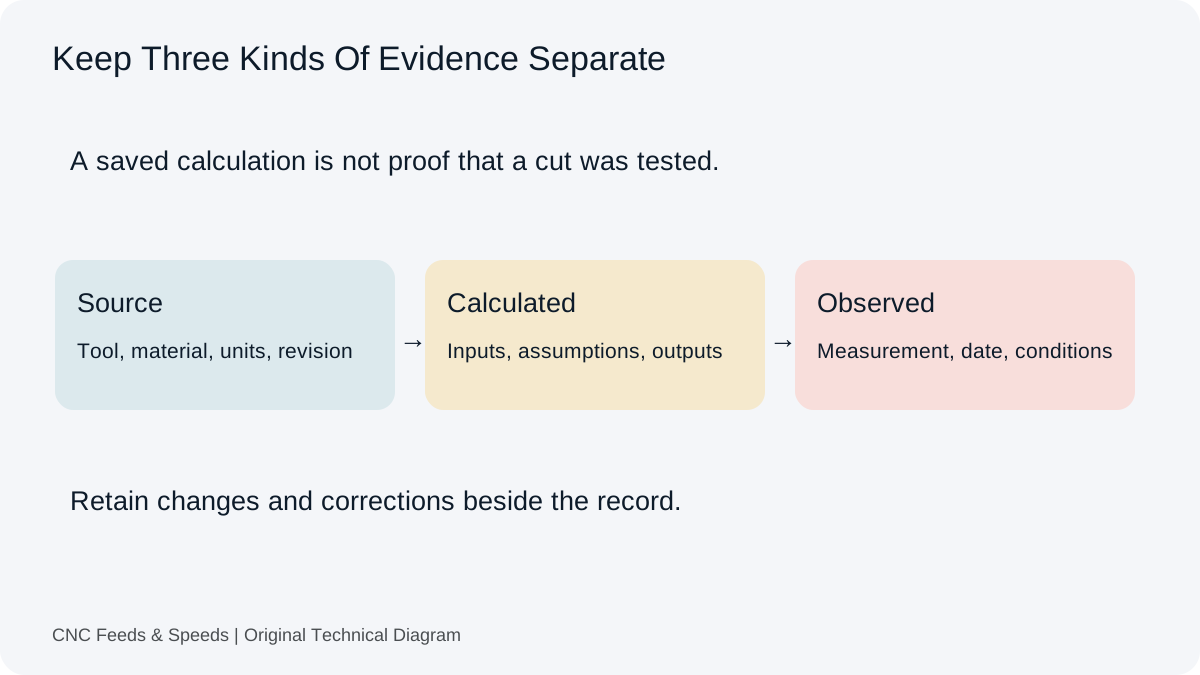
Preserve source data, calculated commands and observed results separately. Use local setup records with clear revisions, units and export limits.
Read Article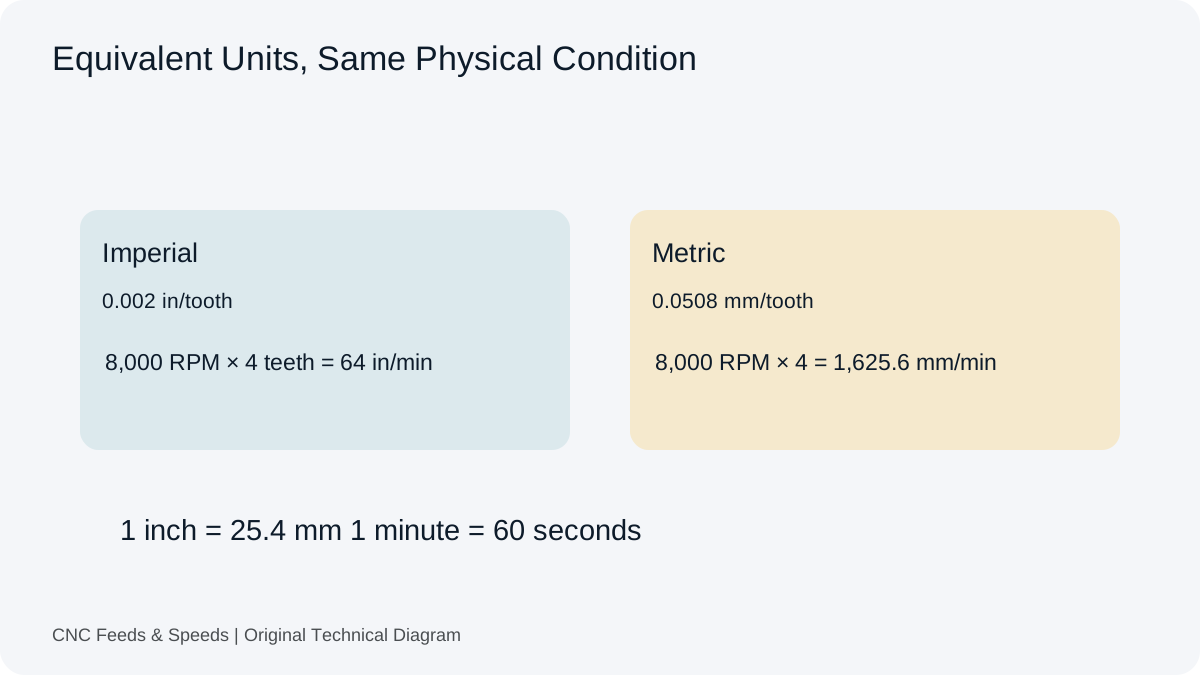
Check length, feed, surface speed, volume and pitch conversions. Follow equivalent metric and imperial examples before transferring a command.
Read Article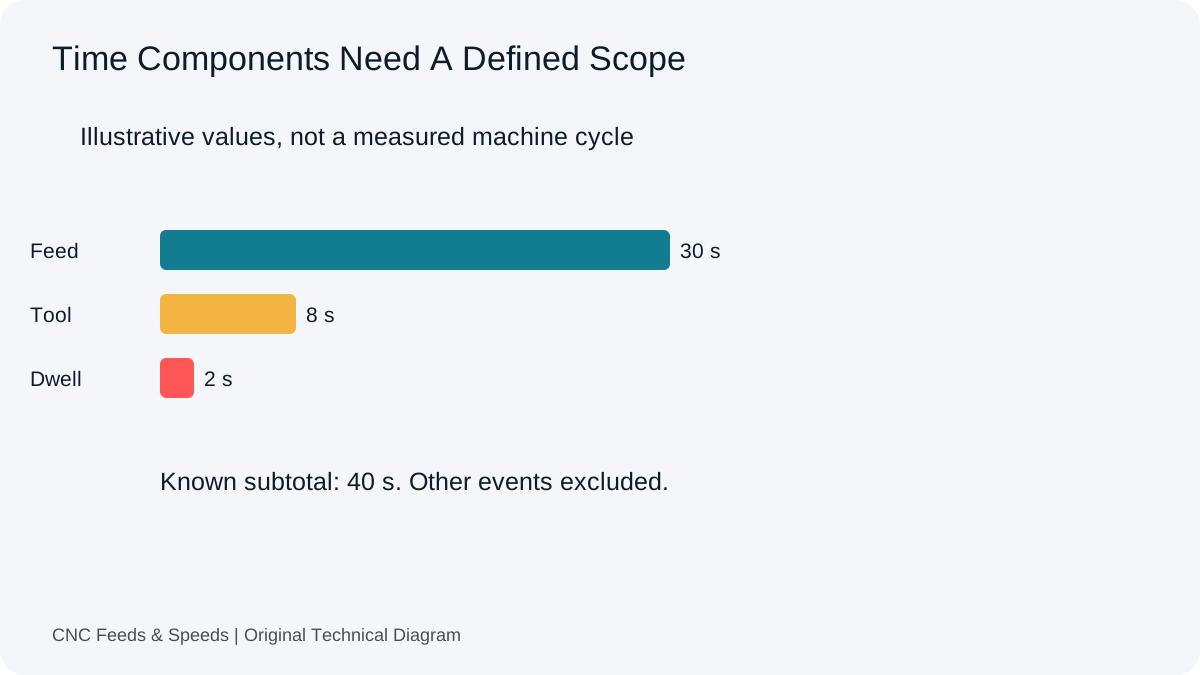
Define the scope behind each time figure. Separate feed travel, machine events, observations and production work before using an estimate.
Read Article
A practical method for interpreting CNC cutting-data charts, matching units, and cross-checking chart values with transparent calculations.
Read Article
Understand how spindle RPM and programmed feed interact, when feed should scale, and why machine limits change the calculation.
Read Article
Learn what surface feet per minute means, how it relates to RPM and diameter, and when to use SFM versus metric cutting speed.
Read Article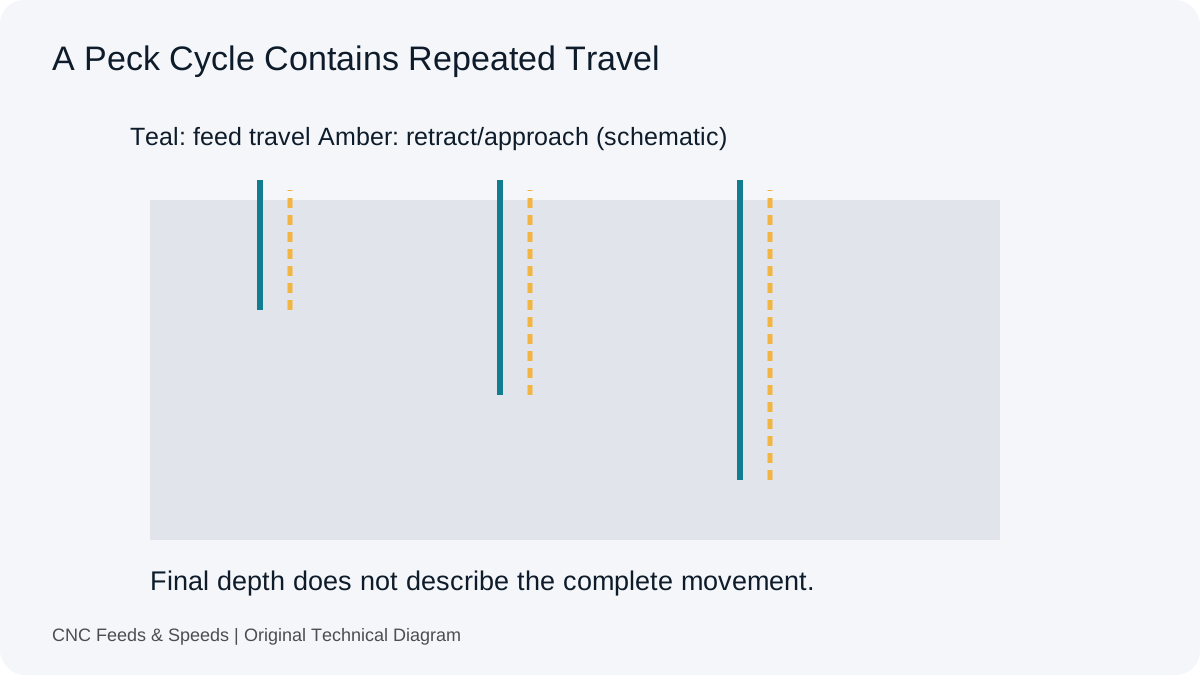
Separate new cutting travel, re-entry, retracts and dwell. Build a transparent time estimate that respects the actual cycle and controller.
Read Article
A practical guide to calculating CNC milling feed rate from spindle speed, flute count and chip load, with unit checks and verification steps.
Read Article
Understand feed per tooth, how chip load is calculated, and how flute count and spindle speed change milling feed.
Read Article
Calculate and interpret material removal rate for CNC milling, including feed, radial engagement and axial depth.
Read Article
Build an aluminum milling starting point from toolmaker cutting speed and chip load, then verify engagement, chip evacuation and machine limits.
Read Article
A calculation-first framework for stainless steel machining that emphasizes tool data, chip thickness, rigidity and heat control.
Read Article