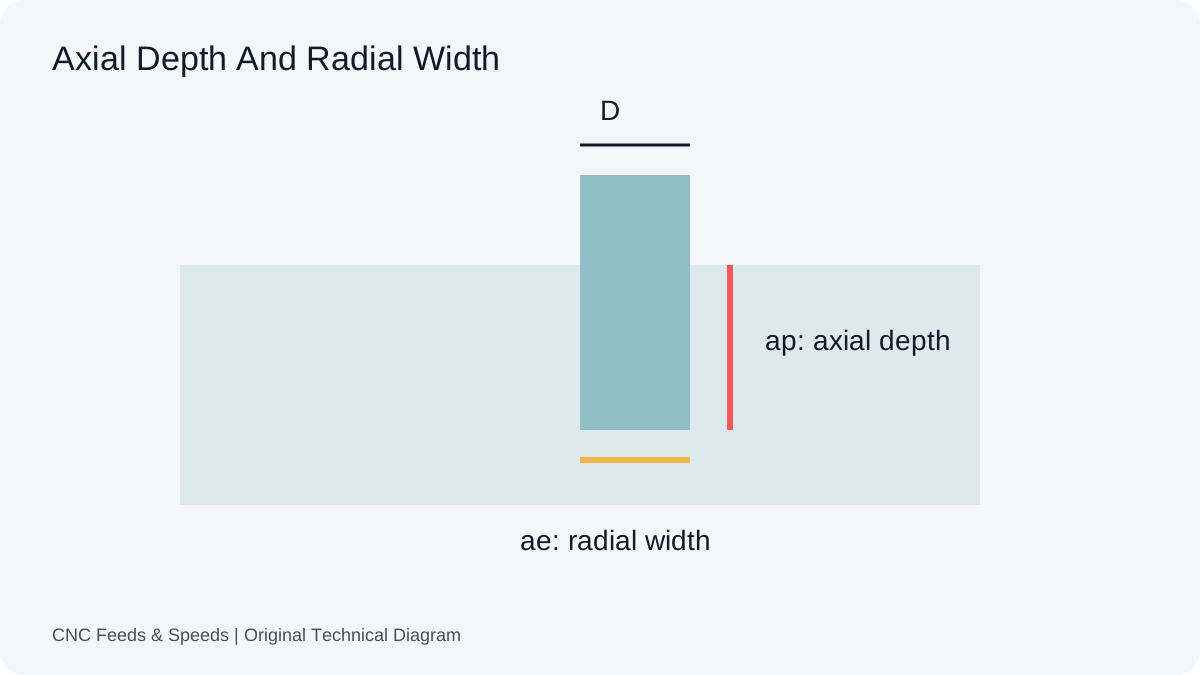
Material removal rate (MRR) is removed volume per unit time. For a constant-section milling cut, multiply linear feed by radial width and axial depth. With feed in mm/min and both engagement dimensions in mm, the result is mm³/min. It measures volume, not spindle power or the complete machine cycle.

The simplified milling formula
For a basic milling estimate, MRR = F × ae × ap. F is feed rate, ae is radial engagement, and ap is axial depth. If feed is 1,600 mm/min, radial engagement is 5 mm and axial depth is 5 mm, the simplified MRR is 40,000 mm³/min. The same number can be expressed in cm³/min or in³/min after proper unit conversion.
Why MRR is useful
MRR turns feed and engagement into a production-volume measure. Two strategies can have the same spindle speed but very different MRR because one removes a wider or deeper cross-section. Looking at MRR helps explain why a “slow-looking” toolpath can still impose a high material-removal demand.
MRR is not power
A high MRR does not automatically mean high spindle power, but there is a relationship through cutting force and specific cutting energy. Material, tool geometry, chip thickness and engagement affect the force required to remove the volume. Use the calculator to quantify volume; use machine and tooling data to assess whether the machine can support it.
Worked example
A pocketing pass runs at 1,200 mm/min, 4 mm radial engagement and 6 mm axial depth. The simplified MRR is 1,200 × 4 × 6 = 28,800 mm³/min. If the same feed is used with 2 mm radial engagement, the simplified MRR halves to 14,400 mm³/min. That makes engagement a visible productivity lever.
Connection to feed and chip load
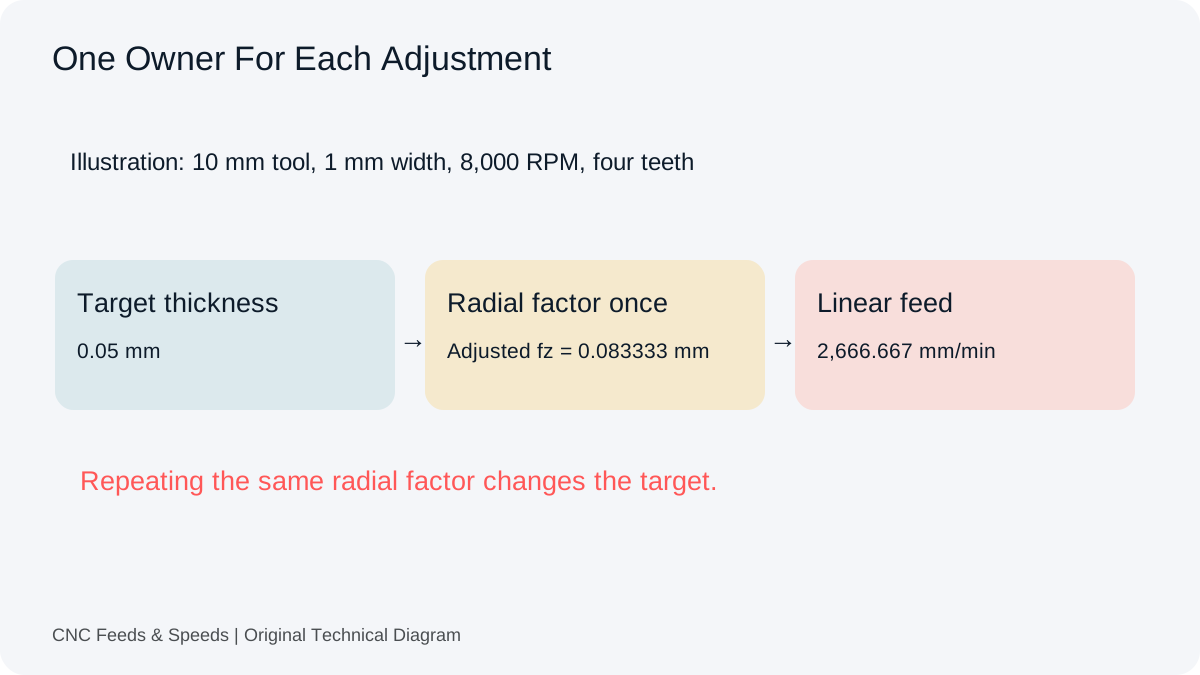
Because MRR uses feed rate, any change in RPM, flute count or chip load that changes feed also changes MRR. This makes MRR a downstream metric. Start with valid cutting inputs, calculate feed, then use MRR to quantify the resulting volume.
MRR and adaptive milling
Low radial engagement strategies can maintain a relatively high programmed feed while reducing instantaneous radial contact. The simplified MRR formula still provides a volume estimate, but it does not encode chip-thinning corrections or dynamic engagement. Use the toolmaker method for chip load and then calculate MRR from the resulting feed and planned engagement.
Turning and drilling MRR
Turning and drilling need different geometric models because the removed shape is not a simple rectangular milling prism. A turning MRR estimate can be derived from diameter change and feed, while drilling can use cross-sectional area and feed. Dedicated calculators are preferable when the operation geometry differs from milling.
Using MRR for optimization
Track MRR alongside spindle load, tool life, surface finish and cycle time. Increasing MRR at the expense of tool life may not improve the job. The useful objective is often a stable process that removes material predictably within machine and tooling limits.
Unit discipline
MRR units multiply three dimensions or a dimensional feed by an area. If feed is in mm/min and both depths are in mm, the result is mm³/min. Converting one input without converting the others creates a silent scaling error.
Frequently asked questions
What is MRR?
Material removal rate is the volume of material removed per unit time.
What is the basic milling MRR formula?
A simplified estimate is feed rate × radial width of cut × axial depth of cut.
Does higher MRR mean faster machining in every case?
It indicates more volume removed per unit time, but practical productivity also depends on tool life, surface finish, machine limits and stability.
Primary formula references: milling volume rate and turning volume rate from Sandvik Coromant. Use the operation-specific variable definitions.
Help Improve This Resource
Request A Tool
Describe the calculation your workflow needs, the inputs you already have and the output you want to check. Include units and an example without confidential job details.
Request A ToolReport An Error
Share this page address, the entered values and the result you expected. Include the source of your comparison so the formula, units and explanation can be investigated.
Report An ErrorCNC Feeds & Speeds Editorial Desk
The site brings calculation tools and machining references into one workspace. Use the editorial and site information to understand its purpose and limitations. Send corrections with a reproducible example through the error report form.