
Request A Tool
Describe the calculation your workflow needs, the inputs you already have and the output you want to check. Include units and an example without confidential job details.
Request A ToolEstimate milling material removal rate from feed, radial width and axial depth. This quantity helps compare the volume removed by two cutting strategies under the stated engagement assumptions.
Estimate milling material removal rate from feed, radial width and axial depth. This quantity helps compare the volume removed by two cutting strategies under the stated engagement assumptions. Keep the width, depth and units with the number. The result describes volume per minute under the entered engagement assumptions, not the machine power needed to sustain it.
Check linear feed, radial width and axial depth of cut.
Milling MRR = feed rate × radial width × axial depth.
Enter the values you know. The result is calculated in your browser.
Calculation only. Verify toolmaker data, material grade, engagement, machine limits, workholding and actual cutting conditions before production.
Review the additional variables shown in this tool.
Enter the values you know. The result is calculated in your browser.
Calculation only. Verify toolmaker data, material grade, engagement, machine limits, workholding and actual cutting conditions before production.
Milling MRR = feed rate × radial width × axial depth.
At 1,000 mm/min feed, 5 mm width and 2 mm depth, the estimate is 10,000 mm³/min, or 10 cm³/min. Dividing cubic millimetres by 1,000 converts to cubic centimetres.
The relationship assumes the entered section is removed along the cutting path. Entry, exit, air cutting, corners and changing engagement mean an instantaneous estimate may differ from average removal across a complete cycle.
Two cuts with the same MRR can have different loads and stability. This tool does not model specific cutting force, spindle power, torque, tool deflection or chip evacuation. Use the separate turning MRR tool for its feed convention.
Check the formula reference or report a result that does not match your calculation.
Illustrative arithmetic only. Select cutting inputs from the applicable tool and material reference.
| Step | Substitution | Result |
|---|---|---|
| Milling Removal Volume | 1,000 × 5 × 2 | 10,000 mm³/min |
| Convert Volume Units | 10,000 ÷ 1000 | 10 cm³/min |
Feed × width × depth assumes a constant removed cross-section along the path. Entries, corners and air cutting can make the cycle average lower. The MRR article explains why a volume rate does not establish available spindle power or complete cycle time.
Formula reference: Sandvik Coromant milling formulas and definitions. Use the exact tool supplier for recommended cutting values.
The milling MRR calculation uses programmed linear feed multiplied by radial width and axial depth. With millimetres and minutes, the product is cubic millimetres per minute; divide by 1000 for cubic centimetres per minute. A CNC MRR comparison is meaningful only when the operation and engagement assumptions match. Use the turning MRR calculator for the surface-speed and feed-per-revolution convention.
Removal volume alone does not say how much power a cut requires. This estimate combines MRR with an applicable specific cutting force, then relates net cutting power to torque at actual spindle RPM. The force value must come from an appropriate tooling or engineering source; no broad material constant is preselected.
Enter the MRR from the calculation above, a documented effective kc value, actual RPM and an assumed mechanical efficiency. kc stays in N/mm² in both unit modes. The imperial MRR input is converted internally before power is calculated, so pressure units are not silently changed.
With MRR in mm³/min, net power Pc = MRR × kc ÷ 60,000,000 in kW. Torque = Pc × 30,000 ÷ (π × RPM) in N·m. Upstream mechanical power = Pc ÷ efficiency, where efficiency is the entered percentage divided by 100.
An assumed MRR of 30,000 mm³/min and kc of 2,000 N/mm² give 1 kW of net cutting power. At 6,000 RPM, the torque is approximately 1.592 N·m. An assumed 80% mechanical efficiency changes upstream mechanical power to 1.25 kW; it does not change the net cutting torque.
Enter the values you know. The result is calculated in your browser.
Calculation only. Verify toolmaker data, material grade, engagement, machine limits, workholding and actual cutting conditions before production.
Compare the estimate with the machine’s available power and torque at the selected speed, not just a nameplate maximum. The model does not include transient loads, spindle acceleration, tool wear, chatter or electrical auxiliaries. A 100% efficiency entry represents an ideal loss-free mechanical path; the upstream result is not measured electrical consumption.
Sandvik Coromant’s milling definitions provide the net-power and torque relationships. The supplied kc must fit the material, chip thickness and tool context. Use the MRR explanation to review volume units and the source directory to keep material identification separate from cutting-data selection.
They are the same volume rate in mm³/min and cm³/min. Divide cubic millimetres by 1000 to obtain cubic centimetres.
Use the turning MRR calculator instead. It uses surface speed, radial depth and feed per revolution rather than milling engagement.
Describe the calculation your workflow needs, the inputs you already have and the output you want to check. Include units and an example without confidential job details.
Request A ToolShare this page address, the entered values and the result you expected. Include the source of your comparison so the formula, units and explanation can be investigated.
Report An ErrorThe site brings calculation tools and machining references into one workspace. Use the editorial and site information to understand its purpose and limitations. Send corrections with a reproducible example through the error report form.
Continue with the calculation, setup or troubleshooting question closest to your task.
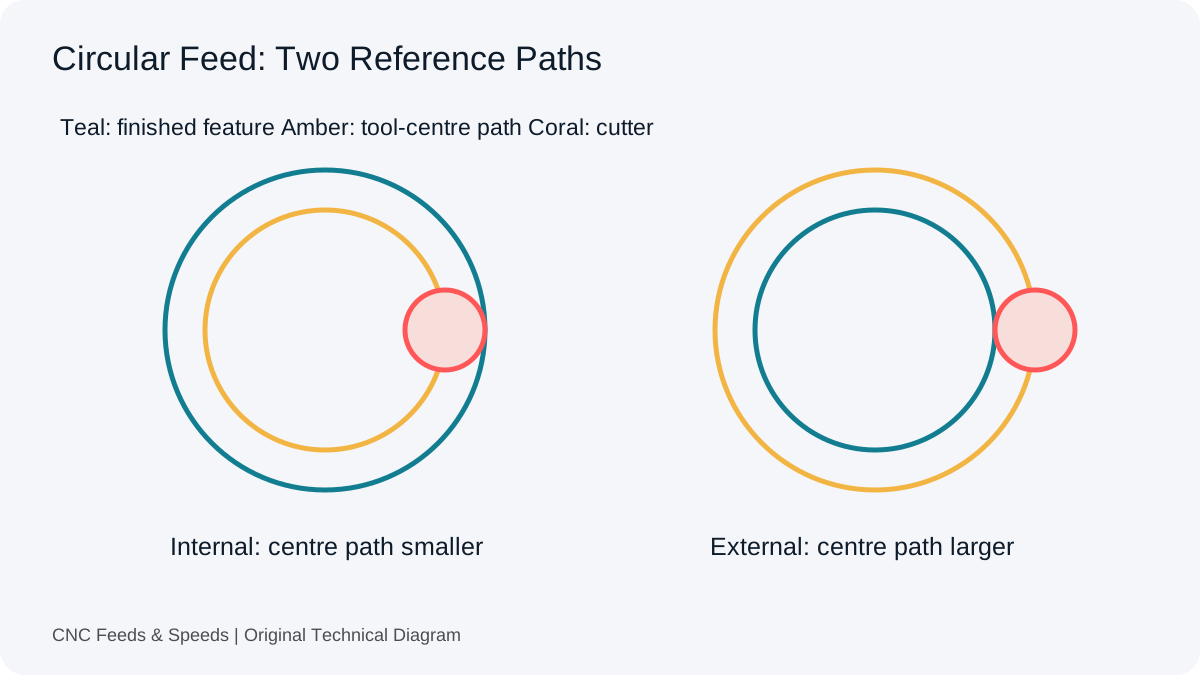
Convert internal and external circular feed with explicit path geometry. Check what CAM already handles before applying another adjustment.
Read Article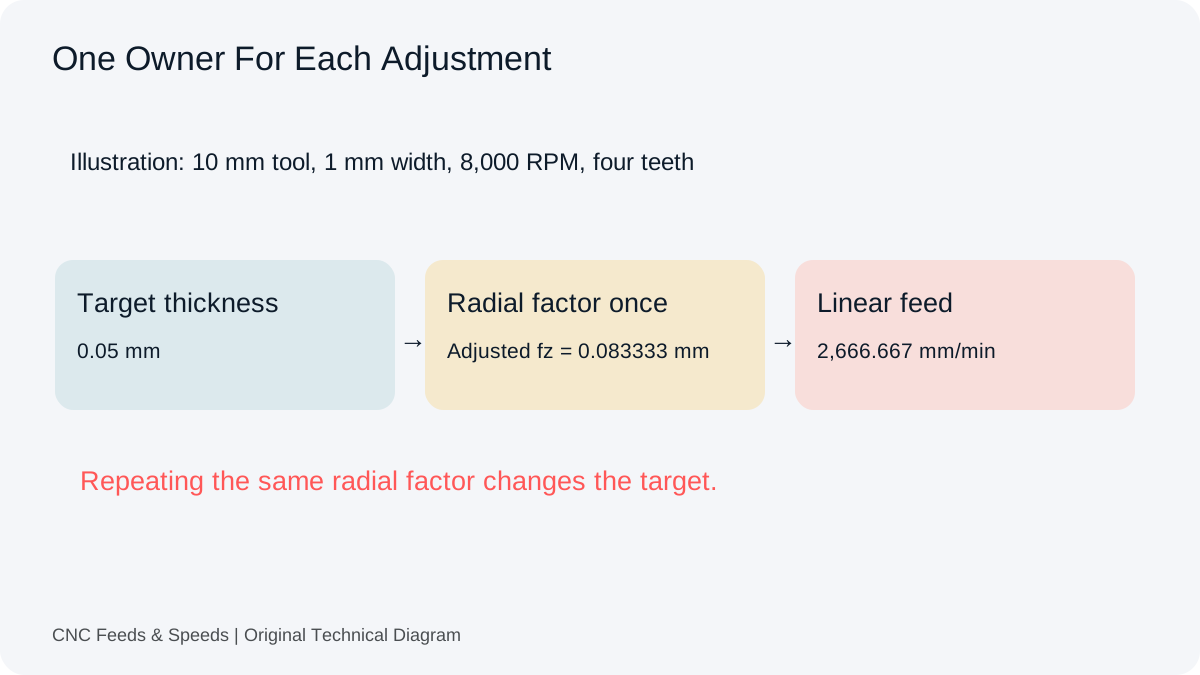
Trace target chip thickness through tooth feed and final command. Identify where compensation occurs before repeating the same adjustment.
Read Article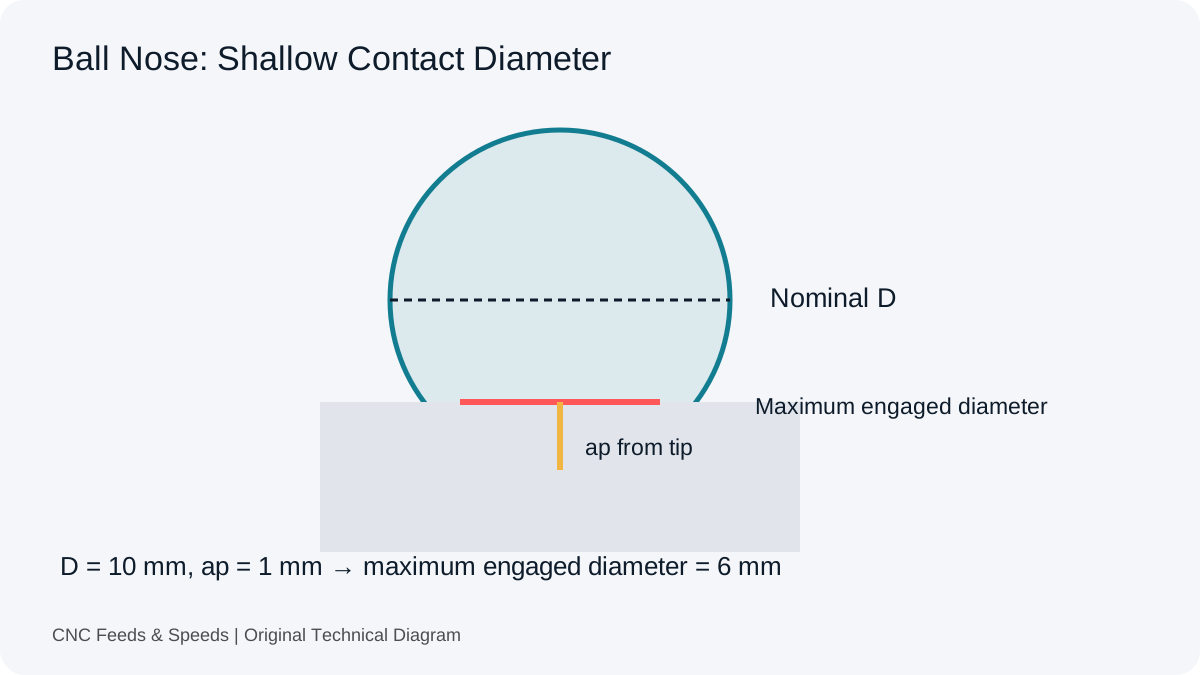
Understand engaged diameter, shallow contact and capped RPM. Keep the untilted model separate from changing three-dimensional surfaces.
Read Article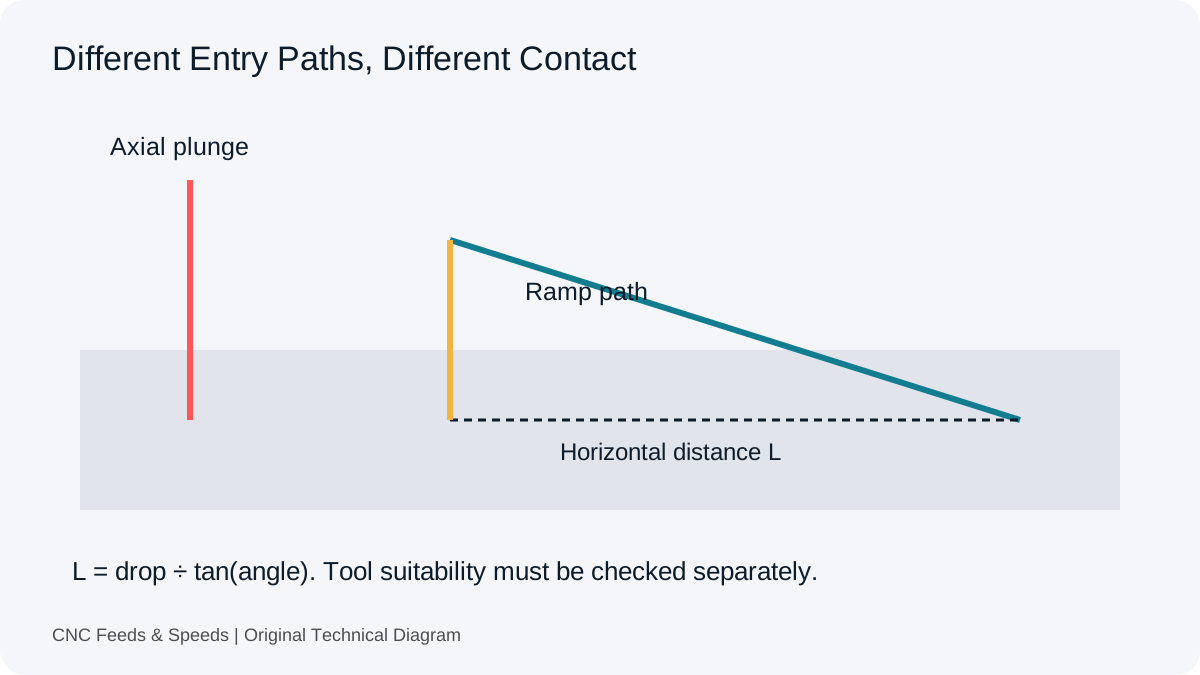
Review entry capability, ramp geometry and chip clearance. Understand why a universal percentage cannot choose a suitable plunge or ramp condition.
Read Article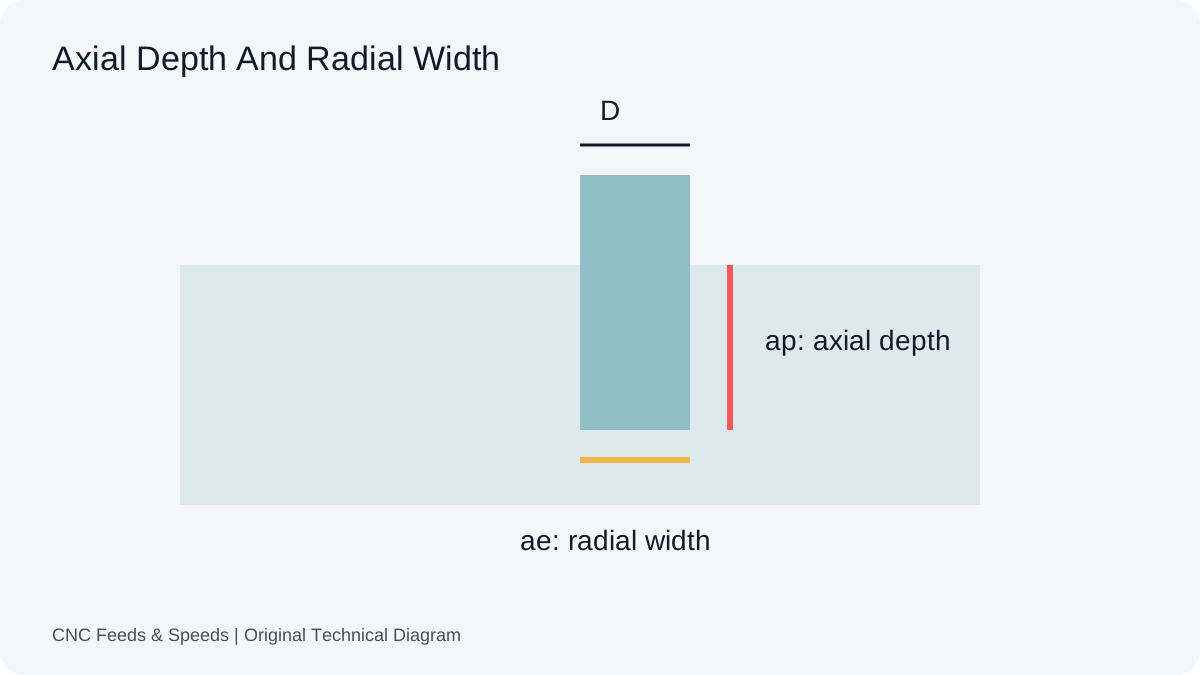
Distinguish tool diameter, axial depth and radial width. Convert engagement percentages and compare removal volume without assuming equal tool load.
Read Article
Understand feed per tooth, how chip load is calculated, and how flute count and spindle speed change milling feed.
Read Article
A practical guide to calculating CNC milling feed rate from spindle speed, flute count and chip load, with unit checks and verification steps.
Read Article
Calculate and interpret material removal rate for CNC milling, including feed, radial engagement and axial depth.
Read Article
A practical method for interpreting CNC cutting-data charts, matching units, and cross-checking chart values with transparent calculations.
Read Article
Learn what surface feet per minute means, how it relates to RPM and diameter, and when to use SFM versus metric cutting speed.
Read Article
Understand how spindle RPM and programmed feed interact, when feed should scale, and why machine limits change the calculation.
Read Article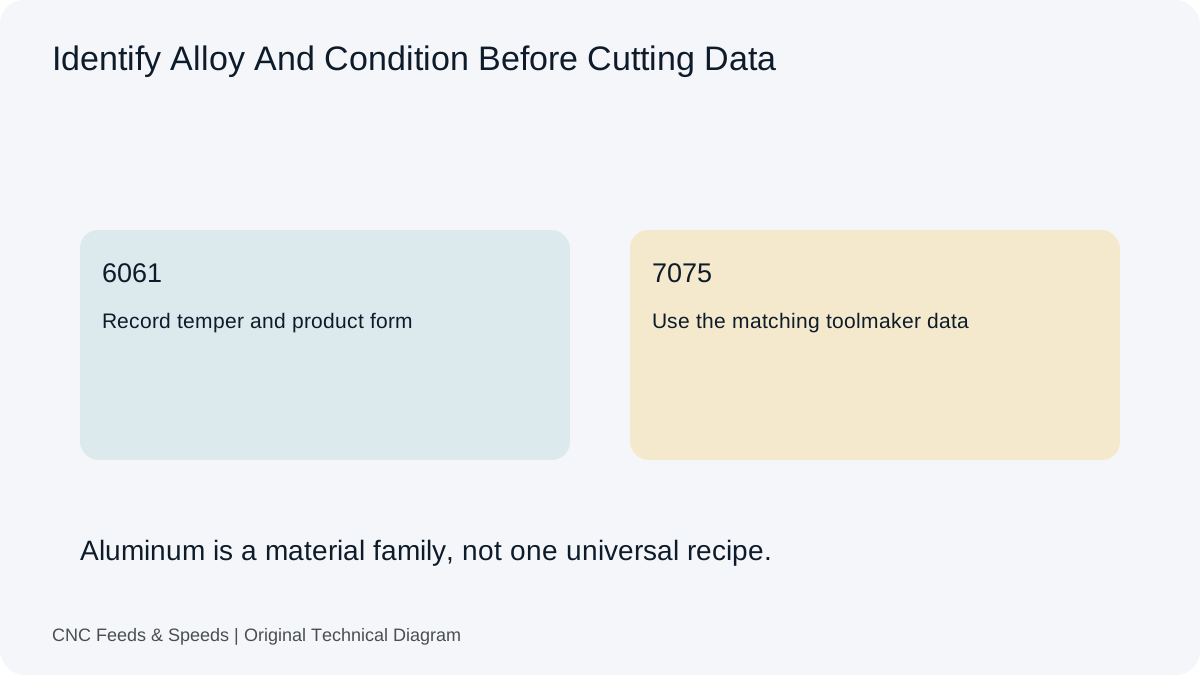
Build an aluminum milling starting point from toolmaker cutting speed and chip load, then verify engagement, chip evacuation and machine limits.
Read Article