
Request A Tool
Describe the calculation your workflow needs, the inputs you already have and the output you want to check. Include units and an example without confidential job details.
Request A ToolConvert spindle RPM and thread pitch into synchronized tapping feed. The relationship follows the thread lead for a conventional single-start thread. Check the machine cycle and tap supplier instructions before using the value.
Convert spindle RPM and thread pitch into synchronized tapping feed. The relationship follows the thread lead for a conventional single-start thread. Check the machine cycle and tap supplier instructions before using the value.
Check spindle RPM and single-start pitch or threads per inch.
Metric single-start feed = RPM × pitch in mm. Imperial single-start feed = RPM ÷ TPI.
Enter the values you know. The result is calculated in your browser.
Calculation only. Verify toolmaker data, material grade, engagement, machine limits, workholding and actual cutting conditions before production.
Review the additional variables shown in this tool.
Enter the values you know. The result is calculated in your browser.
Calculation only. Verify toolmaker data, material grade, engagement, machine limits, workholding and actual cutting conditions before production.
Metric single-start feed = RPM × pitch in mm. Imperial single-start feed = RPM ÷ TPI.
At 500 RPM with a 1.5 mm pitch, synchronized feed is 750 mm/min. At 500 RPM and 20 TPI, feed is 25 in/min. TPI is threads per inch, not an inch value for pitch.
For a multi-start thread, lead differs from pitch. The basic pitch equation must not be applied silently to that case. Check the specified thread geometry and the conventions expected by the control.
The calculator supplies arithmetic. It does not establish that a machine supports rigid tapping, choose holder compensation or define reversal settings. Changing spindle speed during a tapping cycle requires the correct synchronized machine behaviour.
Check the formula reference or report a result that does not match your calculation.
Illustrative arithmetic only. Select cutting inputs from the applicable tool and material reference.
| Step | Substitution | Result |
|---|---|---|
| Single-Start Feed | 500 × 1.5 | 750 mm/min |
These panels use pitch as lead for a conventional single-start thread. Multiple starts require a separate lead calculation, and the machine cycle must support the intended motion. The tapping workspace covers thread inputs and cycle checks without selecting hole size or tap style.
A tap speed and feed calculation connects spindle rotation to thread lead. For a conventional single-start metric thread, lead equals pitch, so RPM × pitch gives feed in millimetres per minute. In imperial mode, the tool uses threads per inch to obtain feed per revolution. The feed rate calculator for tapping therefore follows thread geometry rather than milling tooth feed.
Confirm whether the source gives pitch, TPI or lead before entering a number. A multi-start thread has lead equal to pitch multiplied by the number of starts; this tool expects the conventional single-start relationship. Check the machine tapping cycle and feed-mode requirements against its documentation. The tapping reference provides supporting context without replacing the control instructions.
The displayed imperial field expects TPI (threads per inch). It calculates lead as 1 ÷ TPI. Do not enter an inch pitch into that field.
Yes. It applies the entered spindle ceiling before calculating synchronized tapping feed. Confirm the resulting values against the supported machine cycle.
Describe the calculation your workflow needs, the inputs you already have and the output you want to check. Include units and an example without confidential job details.
Request A ToolShare this page address, the entered values and the result you expected. Include the source of your comparison so the formula, units and explanation can be investigated.
Report An ErrorThe site brings calculation tools and machining references into one workspace. Use the editorial and site information to understand its purpose and limitations. Send corrections with a reproducible example through the error report form.
Continue with the calculation, setup or troubleshooting question closest to your task.
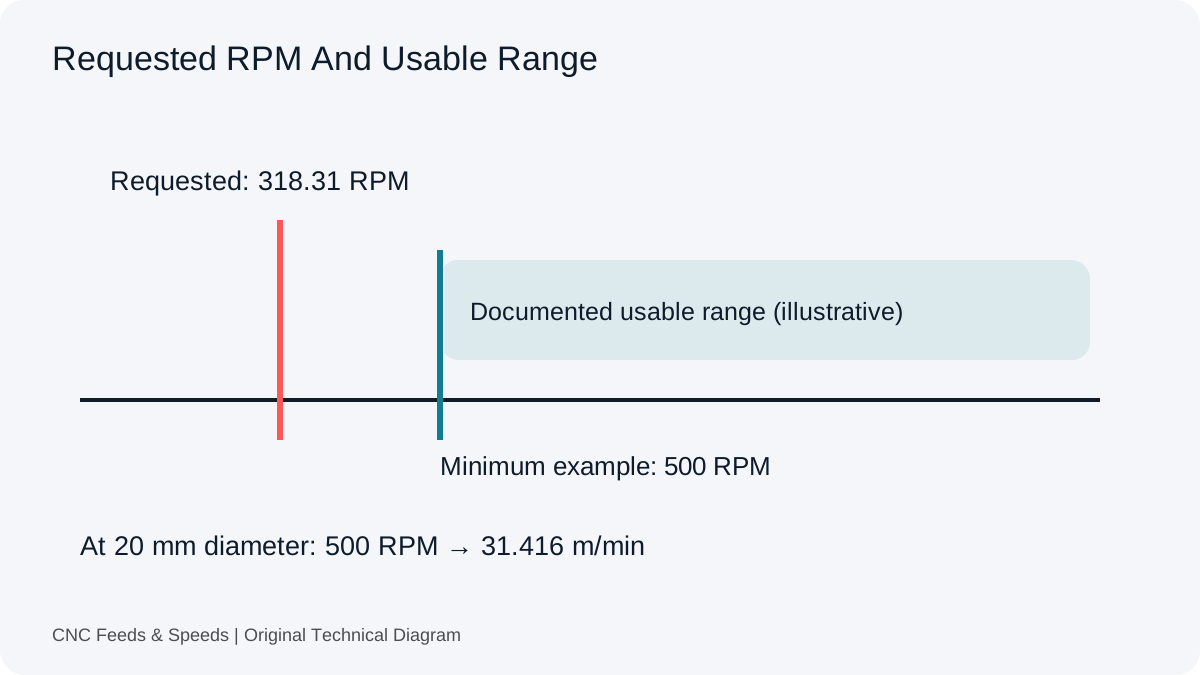
Compare drill requirements with the usable spindle range. Calculate achieved cutting speed without treating feed adjustment as a cure for incompatible tooling.
Read Article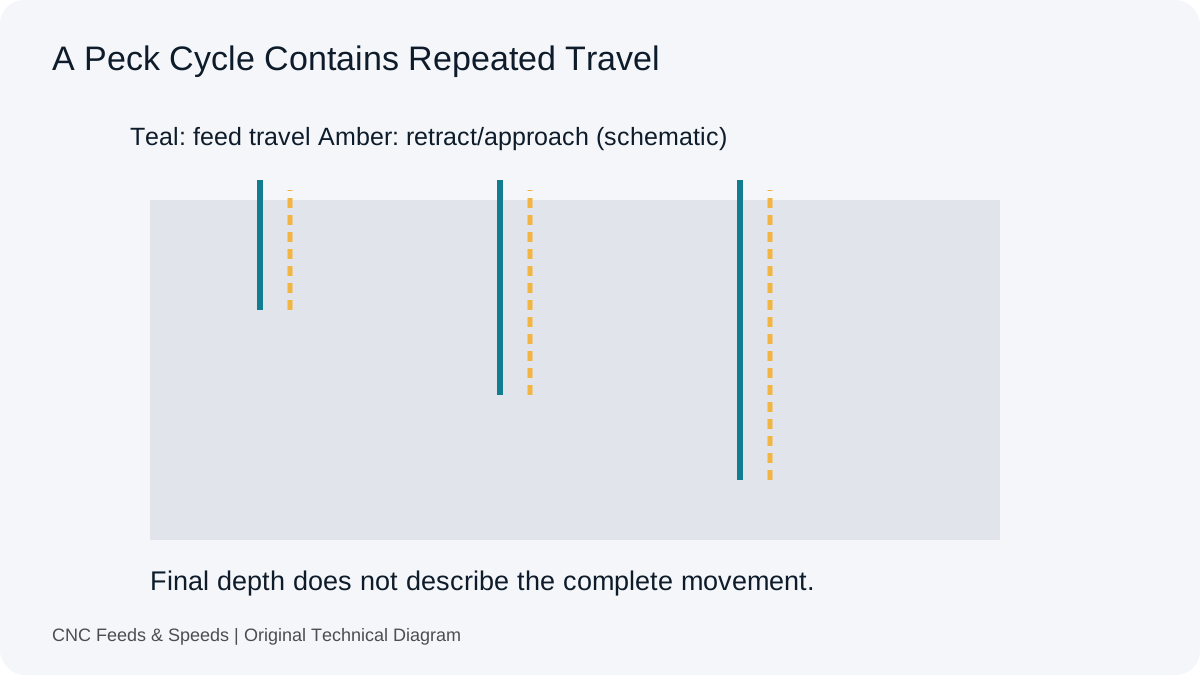
Separate new cutting travel, re-entry, retracts and dwell. Build a transparent time estimate that respects the actual cycle and controller.
Read Article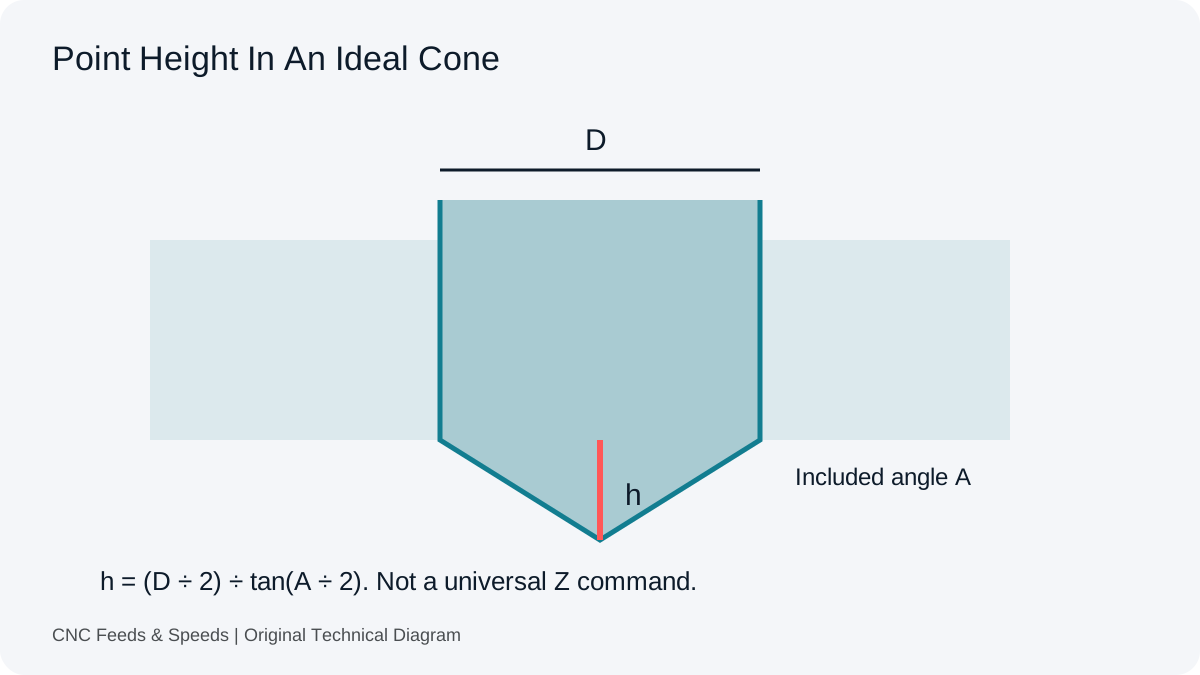
Use an explicitly ideal cone model to understand point allowance. Keep cylindrical depth, tip travel and actual machine clearance separate.
Read Article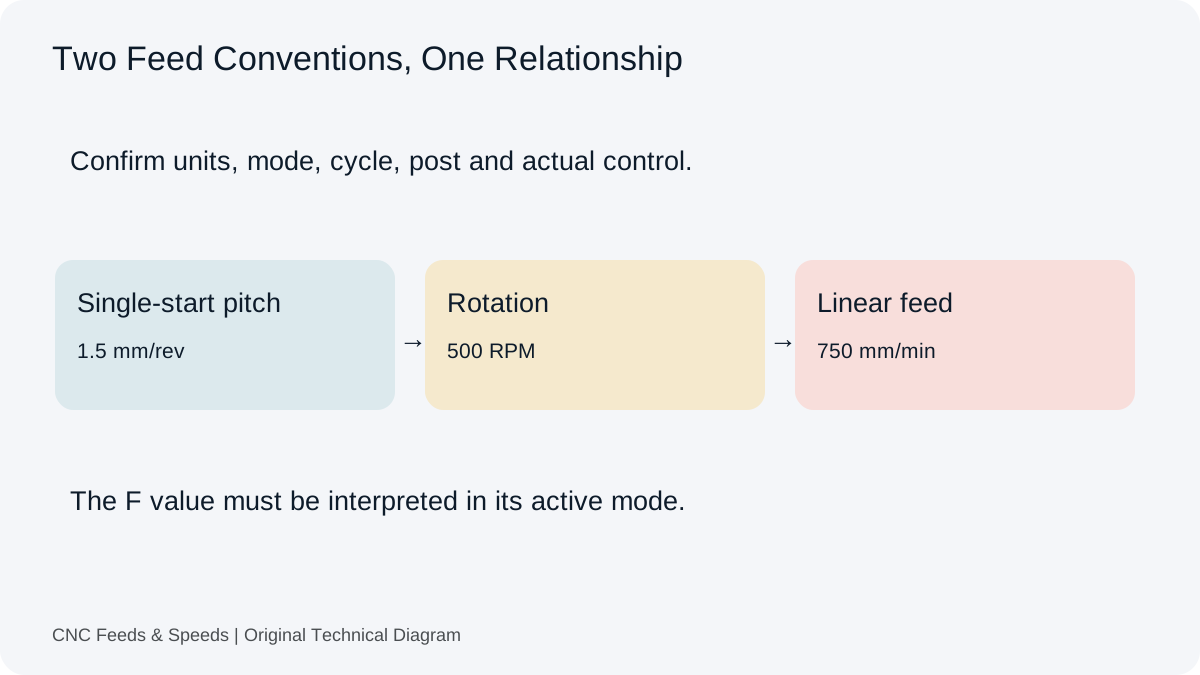
Compare pitch, lead, units and active feed mode. Separate arithmetic from post-processor behaviour and controller-specific tapping requirements.
Read Article
Understand how spindle RPM and programmed feed interact, when feed should scale, and why machine limits change the calculation.
Read Article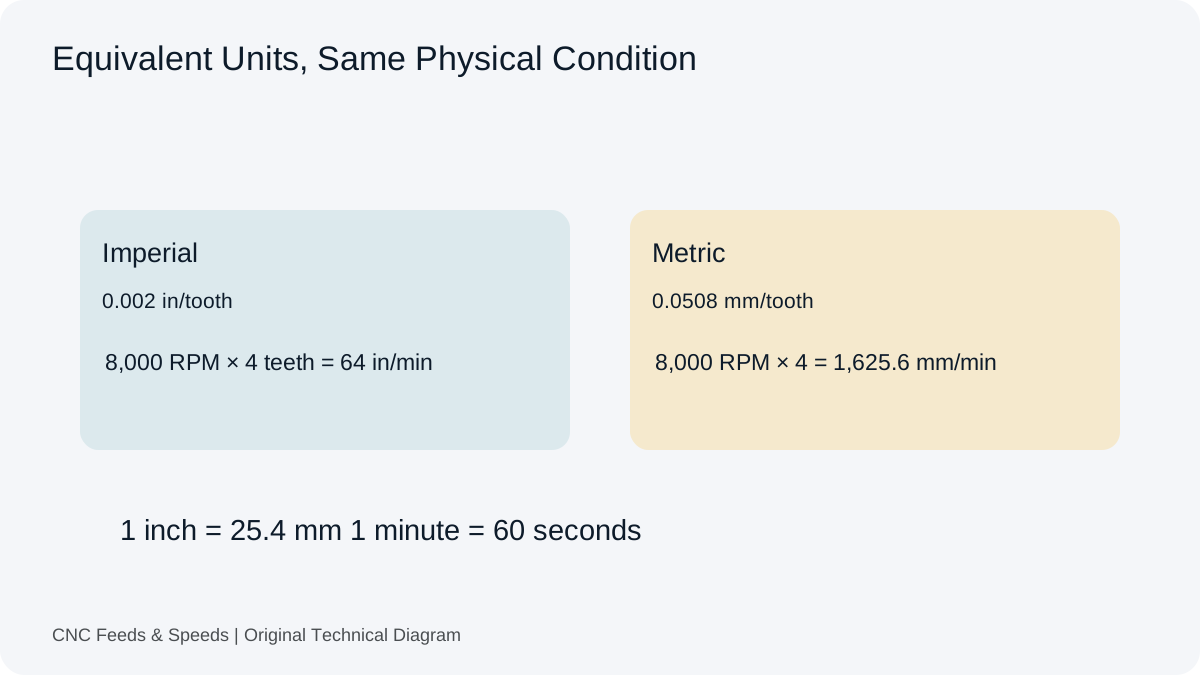
Check length, feed, surface speed, volume and pitch conversions. Follow equivalent metric and imperial examples before transferring a command.
Read Article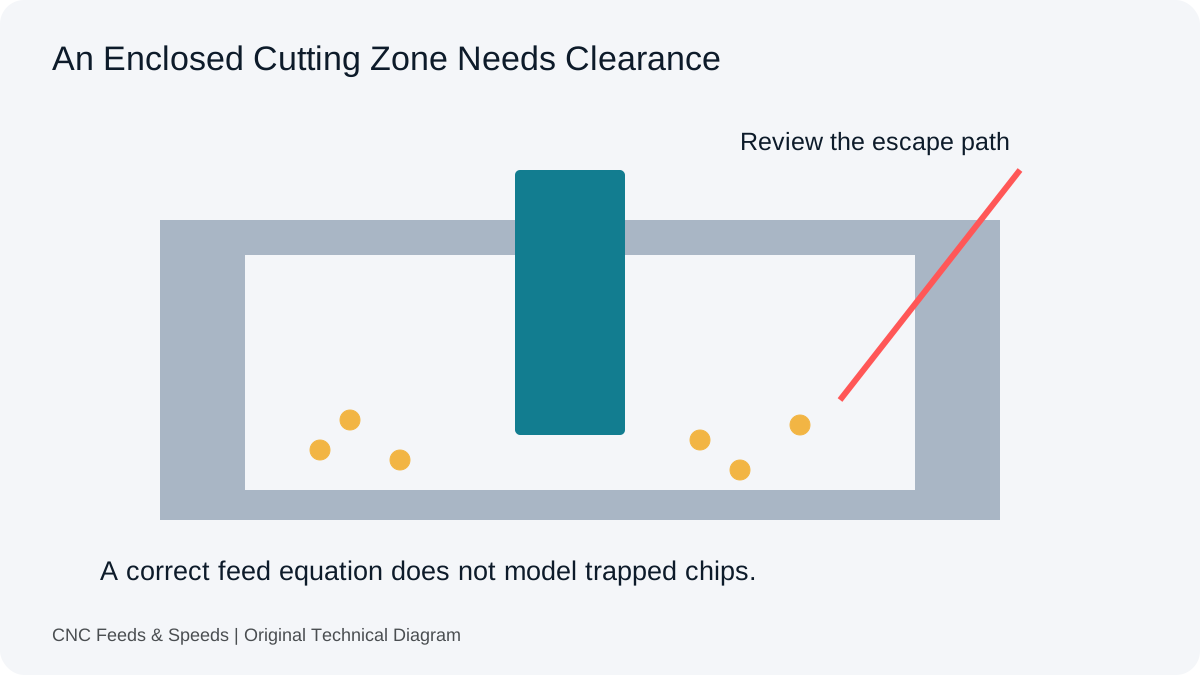
Distinguish arithmetic errors from an enclosed cutting zone. Review entry, tooling, material and chip clearance before another feed change.
Read Article
A practical guide to calculating CNC milling feed rate from spindle speed, flute count and chip load, with unit checks and verification steps.
Read Article
Understand feed per tooth, how chip load is calculated, and how flute count and spindle speed change milling feed.
Read Article
A practical method for interpreting CNC cutting-data charts, matching units, and cross-checking chart values with transparent calculations.
Read Article
Learn what surface feet per minute means, how it relates to RPM and diameter, and when to use SFM versus metric cutting speed.
Read Article
Calculate and interpret material removal rate for CNC milling, including feed, radial engagement and axial depth.
Read Article