
Request A Tool
Describe the calculation your workflow needs, the inputs you already have and the output you want to check. Include units and an example without confidential job details.
Request A ToolDrilling reference covering drill speed, feed per revolution, hole depth, chip evacuation and coolant.
A drilling reference normally relates cutting speed and drill diameter to RPM, then uses feed per revolution to establish linear feed. Confirm that the source really states mm/rev or in/rev. A milling tooth-feed value follows a different convention and should not be copied into the same calculation without explanation.
Use the appropriate metric or imperial RPM equation with the cutting diameter. Compare the result with the machine range, then use actual RPM when calculating linear feed. If the spindle setting changes, preserving the intended feed per revolution requires another feed calculation.
A basic feed equation contains no model of hole depth, coolant delivery or chip evacuation. Follow the drill supplier guidance for the actual depth ratio and tool construction. A shallow-hole result does not establish the conditions for a deeper blind hole, even when diameter and material are unchanged.
Point geometry, holder runout, material condition and the intended hole tolerance remain outside the arithmetic. Keep the exact drill identification with the source data. On the first hole, record the dimensional result and relevant observations so later changes can be compared with a documented condition.
Open The Relevant Calculator | Review Formulas And Units
The cutting chart guide helps identify a per-revolution feed before it is converted to linear feed. The carbide and HSS article explains why tool construction should remain with the source data. Use the drilling workspace to calculate forward feed and inspect the reverse check.
Sandvik Coromant drilling formulas define the relationships among cutting speed, drill diameter, rotation and penetration rate. The time relationship describes feed travel; it does not automatically include peck retractions or every event in a machine cycle.
Depth is not a term in the surface-speed-to-RPM equation. It still affects the process, coolant access and the supplier’s application guidance.
Open the drilling workspace. Keep the supplier feed-per-revolution value with the calculated RPM rather than converting it into an unrelated tooth-feed input.
Describe the calculation your workflow needs, the inputs you already have and the output you want to check. Include units and an example without confidential job details.
Request A ToolShare this page address, the entered values and the result you expected. Include the source of your comparison so the formula, units and explanation can be investigated.
Report An ErrorThe site brings calculation tools and machining references into one workspace. Use the editorial and site information to understand its purpose and limitations. Send corrections with a reproducible example through the error report form.
Continue with the calculation, setup or troubleshooting question closest to your task.
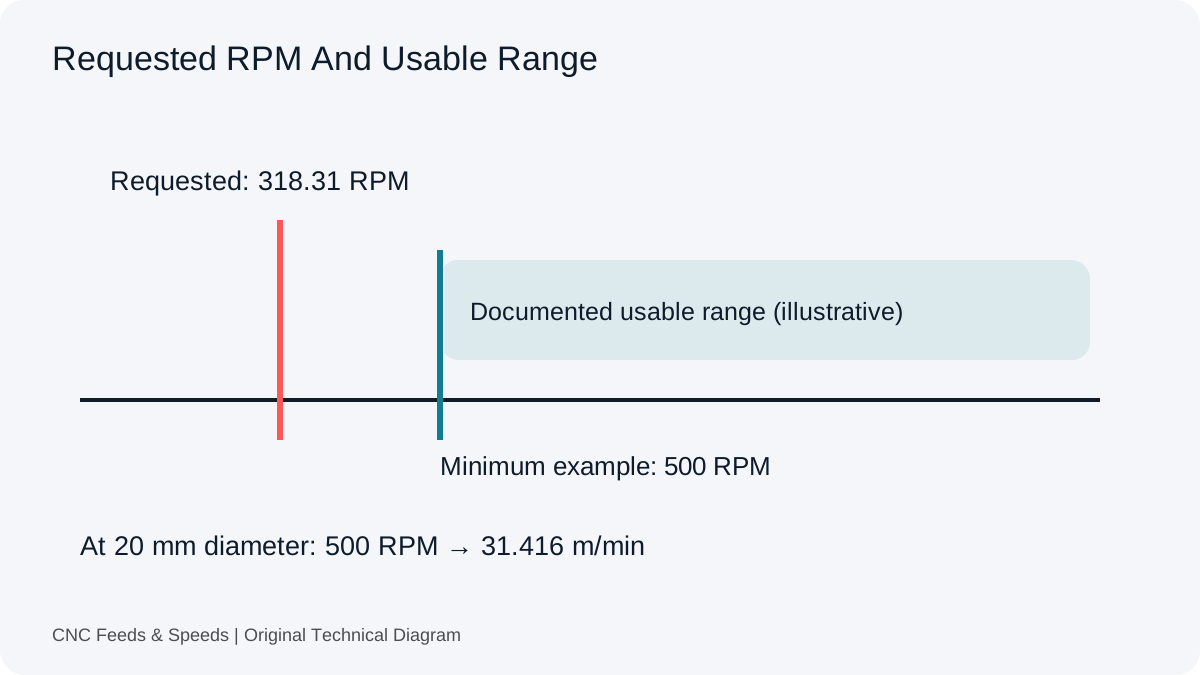
Compare drill requirements with the usable spindle range. Calculate achieved cutting speed without treating feed adjustment as a cure for incompatible tooling.
Read Article
Separate new cutting travel, re-entry, retracts and dwell. Build a transparent time estimate that respects the actual cycle and controller.
Read Article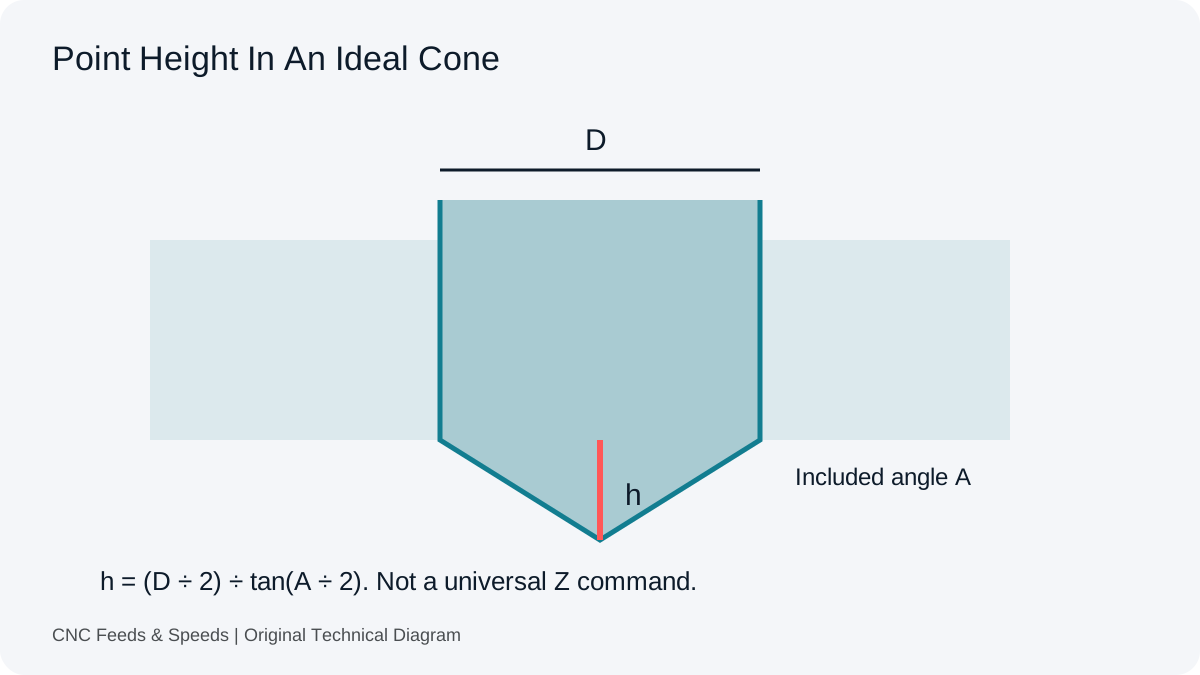
Use an explicitly ideal cone model to understand point allowance. Keep cylindrical depth, tip travel and actual machine clearance separate.
Read Article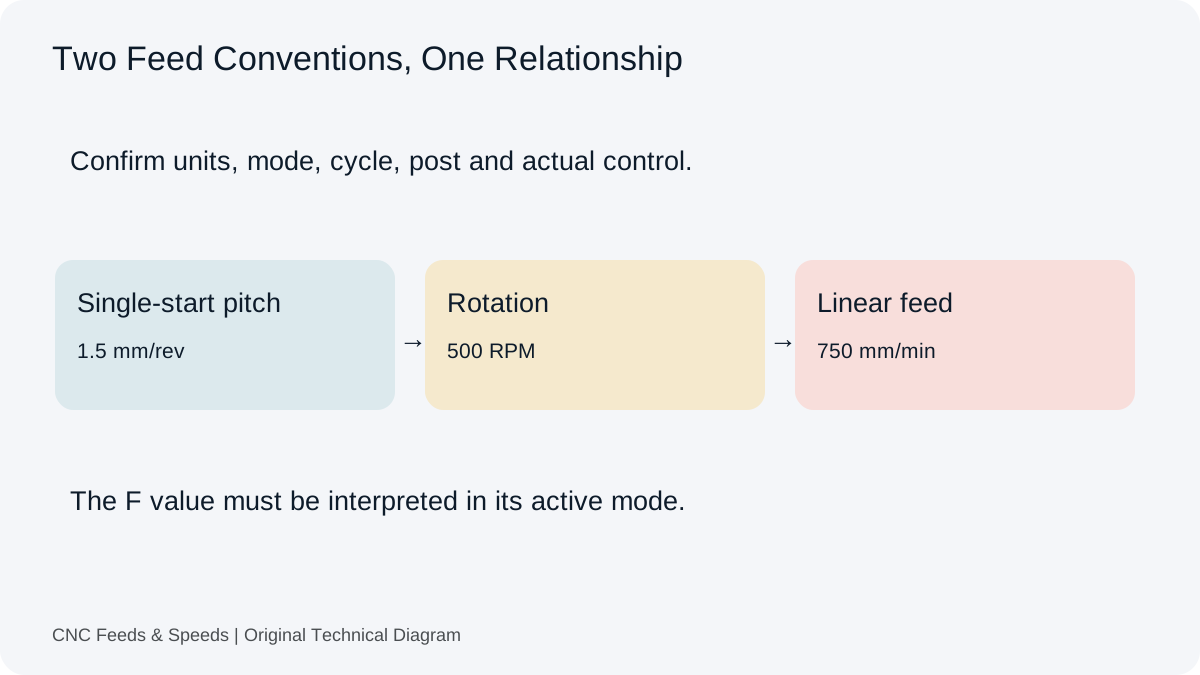
Compare pitch, lead, units and active feed mode. Separate arithmetic from post-processor behaviour and controller-specific tapping requirements.
Read Article
Understand how spindle RPM and programmed feed interact, when feed should scale, and why machine limits change the calculation.
Read Article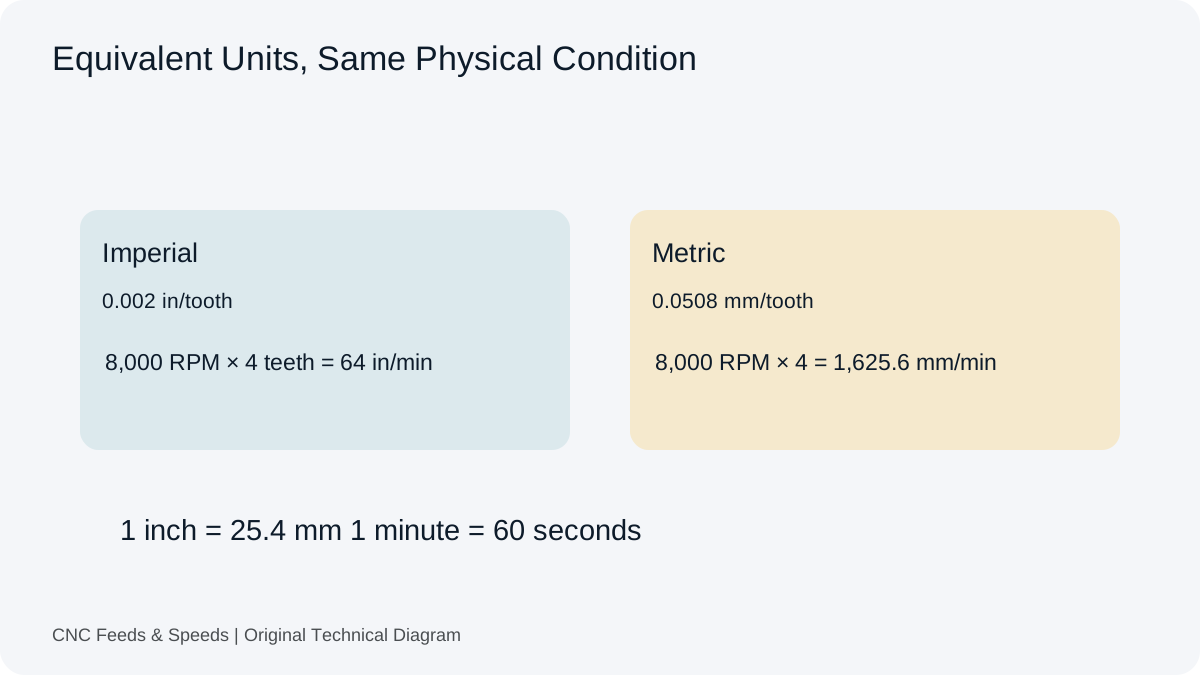
Check length, feed, surface speed, volume and pitch conversions. Follow equivalent metric and imperial examples before transferring a command.
Read Article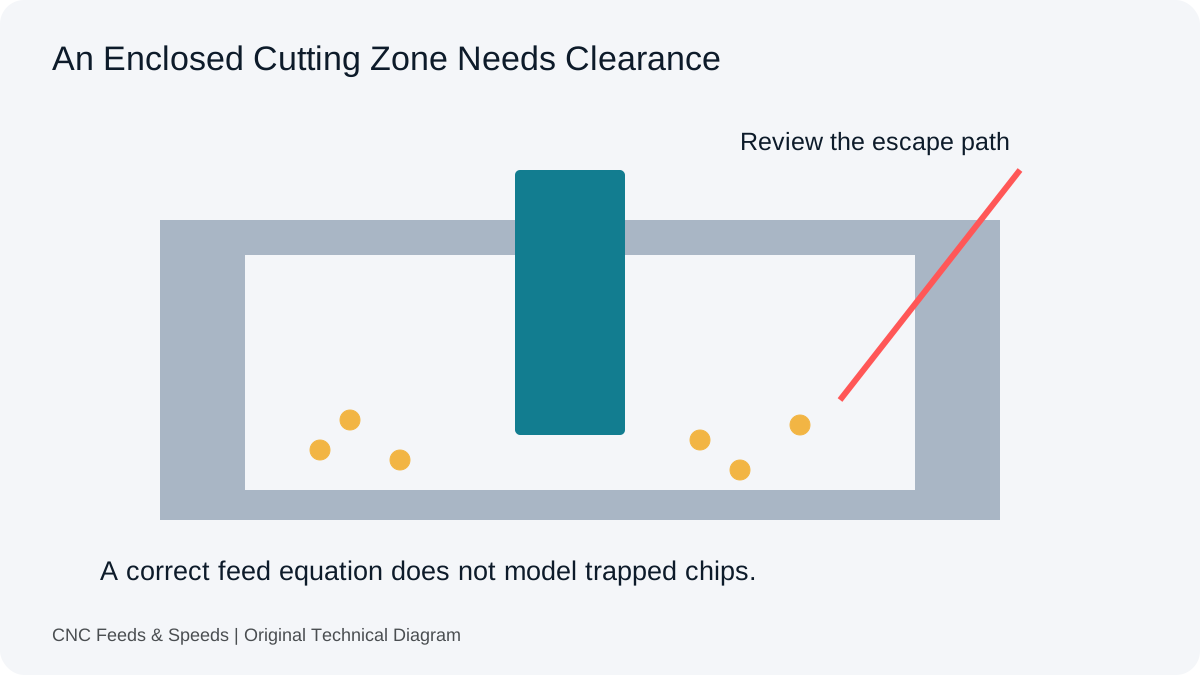
Distinguish arithmetic errors from an enclosed cutting zone. Review entry, tooling, material and chip clearance before another feed change.
Read Article
A practical guide to calculating CNC milling feed rate from spindle speed, flute count and chip load, with unit checks and verification steps.
Read Article
Understand feed per tooth, how chip load is calculated, and how flute count and spindle speed change milling feed.
Read Article
A practical method for interpreting CNC cutting-data charts, matching units, and cross-checking chart values with transparent calculations.
Read Article
Learn what surface feet per minute means, how it relates to RPM and diameter, and when to use SFM versus metric cutting speed.
Read Article
Calculate and interpret material removal rate for CNC milling, including feed, radial engagement and axial depth.
Read Article